The short definition
A shadow board is a wall panel with a cut out or holder shaped to match each individual tool. Every tool has one fixed position, marked by its outline. When the tool is in place, the board looks complete. When a tool is missing, the empty silhouette makes it obvious in a single glance. That visual check replaces searching, asking and guessing.
Where the name comes from
The name comes from the shadow effect of the outline itself. Early boards used painted tool shapes on plywood, and the painted silhouette looked like the tool’s shadow on the wall. Modern boards use precision cut outs, flexible holders and engraved labels, but the principle is unchanged: the empty space tells the truth.
Why shadow boards are part of 5S
Shadow boards are the visual heart of the 5S methodology, specifically the third S, standardise, and they support the second S, set in order. 5S is a five step system for workplace organisation:
- Sort Remove everything not needed for the work.
- Set in order Give every item a fixed, logical position.
- Shine Clean and inspect the area so problems surface.
- Standardise Make the arrangement the way work is always done.
- Sustain Keep the system alive through checks and habit.
A shadow board makes the standard visible. The outline is the standard, the empty space is the deviation, and anybody can read both without training.
What a shadow board does in practice
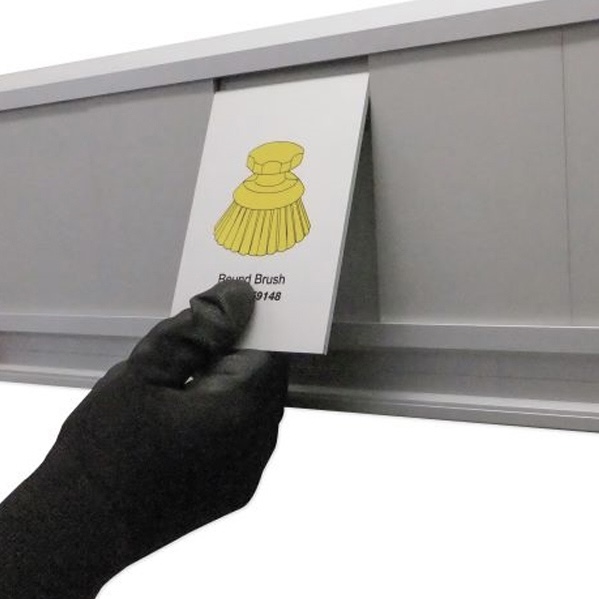
Teams use shadow boards for handover checks, tool crib control, audit evidence and changeover preparation. The board answers three questions in seconds: what should be here, what is here, and what is missing. In food plants the same logic moves from tools to cleaning equipment, where colour coding and labelled positions stop cross contamination before it happens.
Common materials and formats
Boards are built from plywood, polypropylene, ABS and powder coated steel, depending on the environment. Holders range from cut out foam and spring clips to magnetic mounts and milled seats. Wall fixed boards suit permanent workstations, while mobile boards on castors follow shared tooling. The right format is decided by the work, the washdown regime and the tools themselves.
How to design one for your tools
The practical sequence is simple. List the tools that belong in the area, measure the wall space, decide what must stay visible versus stored, then match a holder to each tool. Labelling each position with the tool name and asset number turns the board into a record as well as a storage system. For most teams, the hardest part is deciding what deserves a place on the board, which is exactly the sorting question 5S starts with.
If you would like a board designed around your actual tool list, send it to us and we will prepare a concept and quote for your project.